
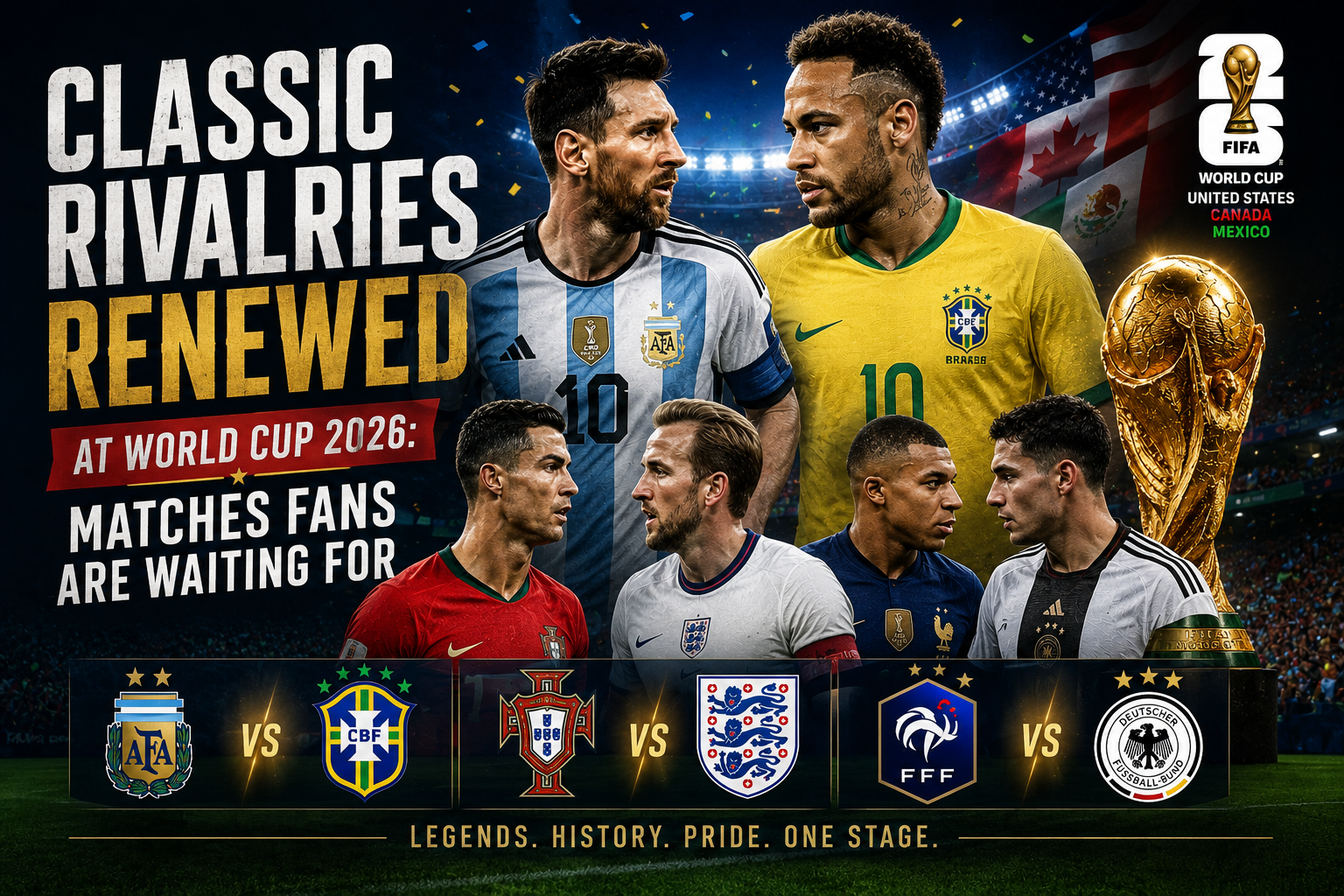
Some matches are bigger than football.
They carry history, emotion, and meaning that goes beyond tactics or form. They’re not just about winning—they’re about proving something. About rewriting narratives. About settling scores that never quite feel settled.
That’s what rivalries bring to the World Cup.
And in 2026, with more teams and more possible matchups than ever before, the chances of seeing these iconic clashes again are higher than ever.
For fans building early World Cup 2026 predictions, these are the matches that add another layer of intensity—because when rivals meet, anything can happen.
Argentina national football team vs Brazil national football team: South America’s Ultimate Clash
Few rivalries in football match the intensity of Argentina vs Brazil.
It’s not just about two teams—it’s about identity. Style vs style. Emotion vs rhythm.
Every encounter feels significant, whether it’s in qualification or a final.
If these two meet in 2026, it won’t just be another match—it will be one of the defining moments of the tournament.
England national football team vs Germany national football team: History That Never Fades
Some rivalries are built on decades of competition.
England vs Germany is one of them.
From historic finals to dramatic knockout matches, their meetings carry a sense of inevitability. There’s always a story attached—something unresolved, something remembered.
If they cross paths again, it will feel less like a coincidence and more like tradition.
France national football team vs England national football team: A Modern Rivalry
Not all rivalries are historic—some are emerging.
France vs England has grown into one of the most compelling matchups in recent tournaments. Both teams are filled with talent, both have expectations, and both are chasing success.
When they meet, the match feels like a test of who belongs at the very top.
Spain national football team vs Netherlands national football team: A Tactical Battle
Some rivalries are defined by style.
Spain vs Netherlands brings contrasting approaches—control vs structure, possession vs discipline.
Their previous encounters have produced both drama and tactical intrigue. If they meet again, it won’t just be about the result—it will be about how the game is played.
Rivalries Beyond the Traditional Powers
With 48 teams in the tournament, new rivalries may also emerge.
Teams that don’t usually meet on the biggest stage could face each other in high-stakes matches, creating new narratives.
The United States men’s national soccer team, playing across United States, could find itself in emotionally charged matches against established football nations.
These moments may not have decades of history—but they can create instant significance.
Why Rivalries Change Matches
Rivalries are different.
They’re less predictable, more emotional, and often less controlled. Players take risks. Fans bring energy. Matches become more intense.
Tactics still matter—but emotion becomes part of the game.
And sometimes, that’s what decides the outcome.
When History Meets the Present
What makes rivalries so compelling is the way they connect past and present.
A match in 2026 isn’t just about current squads—it’s about everything that came before.
Previous results, iconic moments, and unforgettable matches all shape expectations.
Players may change—but the story continues.
The Role of the Tournament Structure
With more teams and more knockout scenarios, the chances of these rivalries happening increase.
Teams may meet earlier than expected—or later, with even higher stakes.
That unpredictability adds to the anticipation.
Because when rivals meet, timing matters as much as form.
A Broader View of Tournament Drama
Rivalries are just one part of what makes the World Cup compelling—but they often define its most memorable moments.
If you want to explore how these matchups could fit into the overall tournament structure, including possible scenarios and outcomes, you can check out 👉 World Cup game predictions for a deeper perspective.
Final Thoughts
The World Cup is built on competition—but it’s elevated by rivalry.
Matches that feel bigger than the tournament itself. Moments that carry history as much as consequence.
In 2026, those moments will return.
Some expected. Some unexpected.
But when they happen, they won’t just decide matches.
They’ll define the tournament.